

TAG:
Clinical Laboratory
A clinical laboratory is a laboratory where tests are done on clinical specimens in order to get information about the health of a patient as pertaining to the diagnosis, treatment, and prevention of disease.
Laboratory medicine is generally divided into two sections, each of which being subdivided into multiple units. These two sections are:
- Anatomic pathology: Units included here are histopathology, cytopathology, and electron microscopy. Other disciplines pertaining to this section include anatomy, physiology, histology, pathology, and pathophysiology.
- Clinical pathology, which includes:
- Clinical Microbiology: This encompasses five different sciences. These include bacteriology, virology, parasitology, immunology, and mycology.
- Clinical Chemistry: Units under this section include instrumental analysis of blood components, enzymology, toxicology and endocrinology.
- Hematology: This section consists of automated and manual analysis of blood cells.
- Genetics is also studied along with a subspecialty known as cytogenetics.
- Reproductive biology: Semen analysis, Sperm bank and assisted reproductive technology.
Credibility of medical laboratories is paramount to the health and safety of the patients relying on the testing services provided by these labs. The international standard in use today for the accreditation of medical laboratories is ISO 15189.
Accreditation is done by the Joint Commission, College of American Pathologists, AAB (American Association of Bioanalysts), and other state and federal agencies. CLIA 88, the Clinical Laboratory Improvement Amendments, also dictate testing and personnel.
In addition, many clinical laboratories have adopted quality management programs such as Six Sigma and Lean quality to improve clinical quality, reduce turnaround time, cut costs, and boost productivity. Lean and Six Sigma are both process improvement methodologies. At a very basic level, Lean is about speed and efficiency, while Six Sigma is about precision and accuracy, leading to data-driven decisions. Lean and Six Sigma methods are finding numerous applications in anatomic pathology laboratories and pathology group practices.
Atrium Health’s Advice on Epic Beaker Rollouts
By Scott Wallask | From the Volume XXX, No. 9 – June 19, 2023 Issue
CEO SUMMARY: Starting in 2019, Atrium Health began a years-long process to implement Epic Beaker as its laboratory information system. It was an enormous effort, involving dozens of locations across three s…
Kaiser Acquires Geisinger Health in Value-Based Deal
By Robert Michel | From the Volume XXX, No. 7 – May 8, 2023 Issue
CEO SUMMARY: This blockbuster combination of two respected integrated delivery networks (IDNs) caught the hospital industry by surprise. Post-closing, Kaiser and Geisinger will have combined revenue…
Kaiser-Geisinger Acquisition Sets Stage for More Deals
By Robert Michel | From the Volume XXX, No. 7 – May 8, 2023 Issue
CEO SUMMARY: Even as experts were predicting more consolidation among multi-hospital health systems at the Executive War College in New Orleans last month, acquisition of Geisinger Health by Kaiser …
Come One, Come All to the Executive War College
By R. Lewis Dark | From the Volume XXX, No. 5 – March 27, 2023 Issue
THIS IS FOR ALL OF YOU LONG-TIME READERS WHO EVERY SPRING SEE NEWS about the Executive War College on Diagnostics, Laboratory, and Pathology Management, tell yourself that you need to attend, but then you…
Six Important Themes to Help Labs Succeed
By Scott Wallask | From the Volume XXX, No. 5 – March 27, 2023 Issue
CEO SUMMARY: Clinical laboratories face business challenges with day-to-day operations, genetic testing, and evolving care delivery models. The 2023 Executive War College on Diagnostics, Clinical Laboratory, and Pathology Management returns on April 25-26 in New Orleans. Participant…
Laboratories Can Find Value in Use of Leftover Samples
By Scott Wallask | From the Volume XXX, No. 5 – March 27, 2023 Issue
CEO SUMMARY: After testing on behalf of patients, there are often leftover samples. One company developed a platform to enable life science customers to access the samples and associated diagnostic data for research purposes. For clinical labs, the leftover samples provide an opport…
Pandemic Helped Lab with Hospital Leaders
By Scott Wallask | From the Volume XXX No. 3 – February 13, 2023 Issue
CEO SUMMARY: Growth at Atrium Health during the COVID-19 pandemic elevated its clinical laboratory’s profile with medical leaders and health system administrators. What followed was a new spirit of collaboration that led to lab involvement in cost savings efforts, such as improved…
February 13, 2023, Intelligence: Late-Breaking Lab News
By Scott Wallask | From the Volume XXX No. 3 – February 13, 2023 Issue
Laboratory leaders should prepare now for the end of the federal public health emergency (PHE) for SARS-CoV-2. The White House announced the PHE would cease on May 11. One big change is that patients covered by Medicare, Medicaid, or private insurance may pay higher costs for COVID-19 t…
Use Histology Laboratory Data to Illustrate Specimen ‘Life Cycle’
By Scott Wallask | From the Volume XXX No. 2 – January 23, 2023 Issue
BECAUSE OF THE CHALLENGING LABOR MARKET, pathology labs need ways to boost staff productivity. To help identify workflow bottlenecks, one approach is to examine lab data and encourage bench teams to think holistically about specimen movement in the lab. [caption id=”attachment_36932″ align=”alignl…
Eight Macro Trends for Clinical Labs Will Shape Diagnostic Services in 2023 and Beyond
By Robert Michel | From the Volume XXX, No. 1 – January 3, 2023 Issue
The Dark Report’s “Eight Macro Trends for Clinical Labs in 2023” delivers the insights that lab administrators and pathologists will want to study as they formulate their future business strategies. These include staffing shortages, factors threatening the stability of…
CURRENT ISSUE
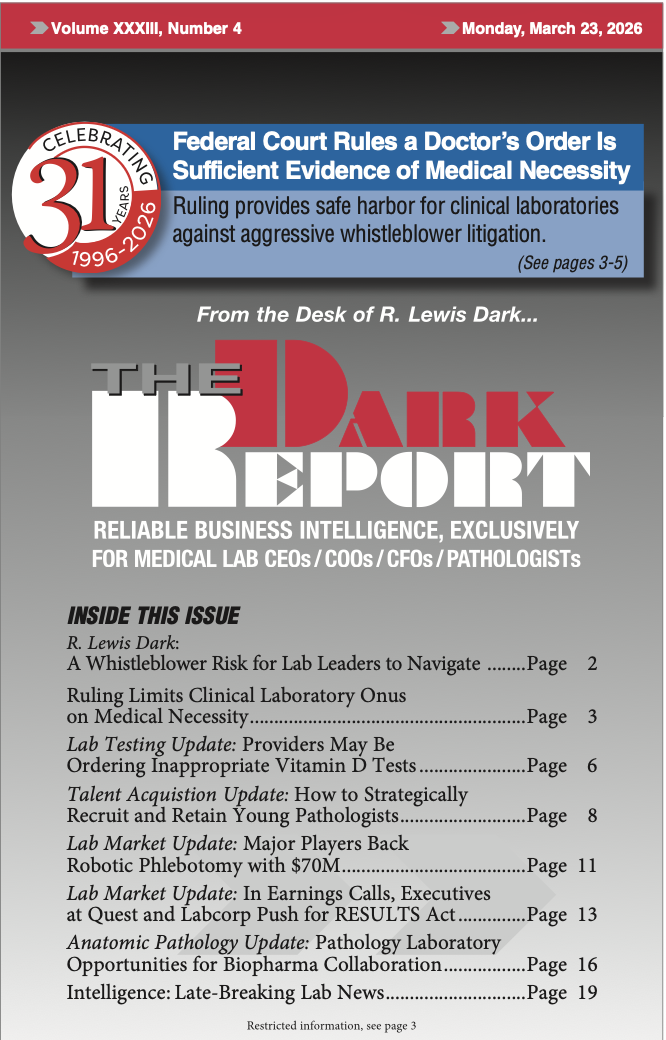
Volume XXXIII, No. 4 – March 23, 2026
A federal court ruling has established a safe harbor for clinical labs when they run tests ordered by physicians. Lab leaders should examine this briefing for pitfalls. Also, it turns out that providers may be ordering inappropriate vitamin D tests, according to one expert.
See the full table of contentsHow Much Laboratory Business Intelligence Have You Missed?
Lab leaders rely on THE DARK REPORT for actionable intelligence on important developments in the business of laboratory testing. Maximize the money you make-and the money you keep! Best of all, it is released every three weeks!
Sign up for TDR Insider
Join the Dark Intelligence Group FREE and get TDR Insider FREE!
Never miss a single update on the issues that matter to you and your business.
Topics
- Anatomic Pathology
- Clinical Chemistry
- Clinical Laboratory
- Clinical Laboratory Trends
- Digital Pathology
- Digital Pathology
- Genetic Testing
- In Vitro Diagnostics
- IVD/Lab Informatics
- Lab Intelligence
- Lab Marketplace
- Lab Risk & Compliance
- Laboratory Automation
- Laboratory Billing
- Laboratory Compliance
- Laboratory Equipment
- Laboratory Information Systems
- Laboratory Management
- Lean Six Sigma
- Managed Care Contracts
- Molecular Diagnostics
- Pathology Trends
- People
- Uncategorized