

Clinical Laboratory
A clinical laboratory is a laboratory where tests are done on clinical specimens in order to get information about the health of a patient as pertaining to the diagnosis, treatment, and prevention of disease.
Clinical laboratories are at the forefront of the personalized medicine trend. However, they are also targets for cost-cutting measures by payers, and increased regulation by CMS and FDA, making the industry a challenging one in which to succeed.
Laboratory medicine is generally divided into two sections, each of which being subdivided into multiple units. These two sections are:
- Anatomic pathology: Units included here are histopathology, cytopathology, and electron microscopy. Other disciplines pertaining to this section include anatomy, physiology, histology, pathology, and pathophysiology.
- Clinical pathology, which includes:
- Clinical Microbiology: This encompasses five different sciences. These include bacteriology, virology, parasitology, immunology, and mycology.
- Clinical Chemistry: Units under this section include instrumental analysis of blood components, enzymology, toxicology and endocrinology.
- Hematology: This section consists of automated and manual analysis of blood cells.
- Genetics is also studied along with a subspecialty known as cytogenetics.
- Reproductive biology: Semen analysis, Sperm bank and assisted reproductive technology.
Credibility of medical laboratories is paramount to the health and safety of the patients relying on the testing services provided by these labs. The international standard in use today for the accreditation of medical laboratories is ISO 15189. Under their respective approaches to laboratory licensure and accreditation, many countries have legal requirements that medical laboratories must be accredited to ISO 15189. This is not true in the United States.
In the United States, there are federal and state laws that address the licensure and accreditation of medical laboratories. Accreditation is done by the Joint Commission, College of American Pathologists, AAB (American Association of Bioanalysts), and other state and federal agencies. CLIA 88, the Clinical Laboratory Improvement Amendments, also dictate testing and personnel.
In addition, many clinical laboratories have adopted quality management programs such as Six Sigma and Lean quality to improve clinical quality, reduce turnaround time, cut costs, and boost productivity. Lean and Six Sigma are both process improvement methodologies. At a very basic level, Lean is about speed and efficiency, while Six Sigma is about precision and accuracy, leading to data-driven decisions. Lean and Six Sigma methods are finding numerous applications in anatomic pathology laboratories and pathology group practices.
Labs in NY & Wash, DC Get Anthrax Test Orders
By Robert Michel | From the Volume XXVI No. 13 – September 23, 2019 Issue
CEO SUMMARY: In both New York City and Washington, DC, widespread publicity about exposure to anthrax generated a steady volume of test requests. Clinical labs in both cities adopted similar management strategies to deal with the sudden public interest in anthrax testing. One common step …
Roche, Digene, Centrex, Labtest.com, Specialty Labs, Tripath Imaging
By Robert Michel | From the Volume XXVI No. 13 – September 23, 2019 Issue
ROCHE DIAGNOSTICS POSITIONED TO SERVE PUBLIC HEALTH LABS HEIGHTENED CONCERNS over bioterrorist attacks have accelerated plans within the public health lab sector to acquire state-of-the art diagnostic technology in DNA typing and enzyme immunoassay. Roche Diagnostics has in…
Nation’s Anthrax Cases Bring Bioterror to Labs
By Robert Michel | From the Volume XXVI No. 13 – September 23, 2019 Issue
CEO SUMMARY: America’s clinical laboratories are soon to be enlisted in the war against terrorism. Concerns about chemical and biological terrorist attacks have reached high levels following the death of a Florida man from pulmonary anthrax and the discovery of letters containing anthra…
Washington G-2, AACC, Cerner, IBM, Visible Genetics, Bio-Reference Labs
By Robert Michel | From the Volume XXVI No. 13 – September 23, 2019 Issue
LAB MEETINGS CONTINUE WITH STRONG ATTENDANCE DESPITE THE HASSLES that now come with cross-country travel, laboratorians throughout the United States continue to support industry meetings. Traditionally the largest lab meeting of the fall season, “Lab Institute 2001” expects good attenda…
NYC Lab Hand-Entered Reqs After Terrorist Acts
By Robert Michel | From the Volume XXVI No. 13 – September 23, 2019 Issue
CEO SUMMARY: Crisis management was the watchword at Centralized Laboratory Services, Inc. of New York City following the terrorist attacks on September 11. Damage around the World Trade Center knocked out the communications link between the lab and a data server which transmitted electron…
Terrorist Attacks Affect Many of Nation’s Labs
By Robert Michel | From the Volume XXVI No. 13 – September 23, 2019 Issue
CEO SUMMARY: Following terrorist attacks in New York City and Washington, DC, the total shutdown of commercial air traffic in the United States for 48 hours disrupted the regular shipment of reference and esoteric lab specimens to national laboratories. Swiftly-implemented contingency eff…
Blood Bankers In USA Swamped by Public Help
By Robert Michel | From the Volume XXVI No. 13 – September 23, 2019 Issue
CEO SUMMARY: Even as news of the terrorist attacks on the World Trade Center and the subsequent collapse of the buildings was captured on national television, people began arriving at blood collection sites to donate blood. It was a growing tidal wave of volunteer blood donors, as their n…
Deluge of Blood Donors Triggers Response by OCD
By Robert Michel | From the Volume XXVI No. 13 – September 23, 2019 Issue
CEO SUMMARY: It’s the story behind the story. Even as overwhelming numbers of people nationwide rushed to donate blood following September 11’s terrorist attacks, blood bankers in many cities found themselves rapidly depleting their existing inventories of supplies and test kits. One …
LabCorp to Help Collect Family DNA Specimens
By Robert Michel | From the Volume XXVI No. 13 – September 23, 2019 Issue
CEO SUMMARY: DNA testing will be a primary tool in identifying victims of this major disaster. Officials in New York City are formulating a plan whereby private labs will do DNA testing in conjunction with New York State Police laboratories. Laboratory Corporation of America has been desi…
Events Trigger Several Responses from Quest
By Robert Michel | From the Volume XXVI No. 13 – September 23, 2019 Issue
CEO SUMMARY: Terrorist attacks on September 11 impacted Quest Diagnostics Incorporated in a number of unexpected ways. Security measures in New York City and Washington, DC impeded normal courier activities. The immediate shutdown of all air traffic nationwide meant that air-freighted spe…
CURRENT ISSUE
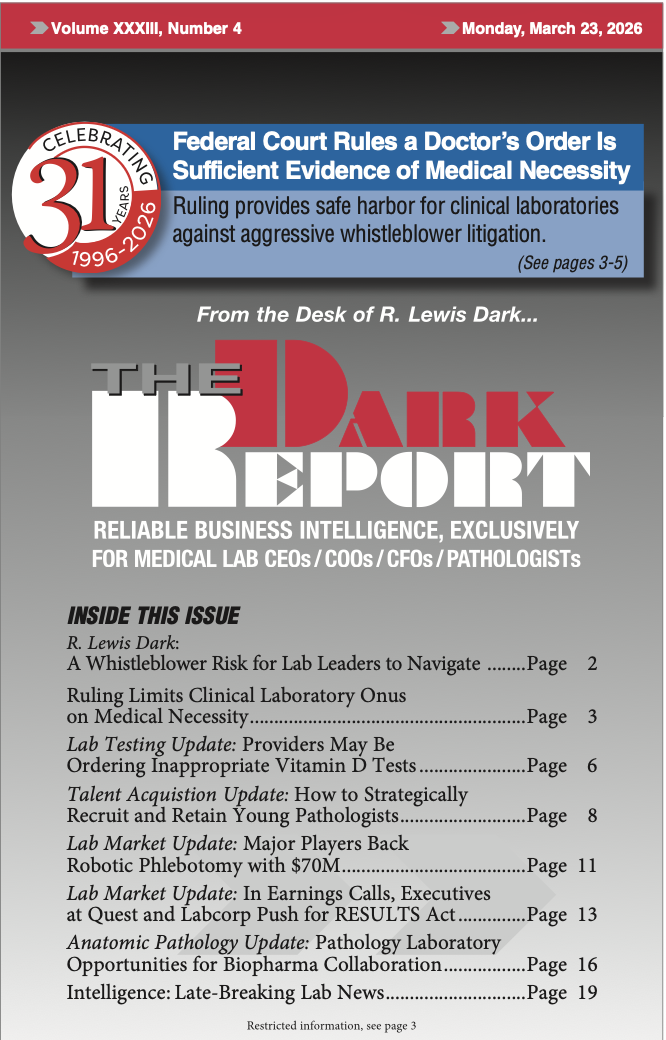
Volume XXXIII, No. 4 – March 23, 2026
A federal court ruling has established a safe harbor for clinical labs when they run tests ordered by physicians. Lab leaders should examine this briefing for pitfalls. Also, it turns out that providers may be ordering inappropriate vitamin D tests, according to one expert.
See the full table of contentsHow Much Laboratory Business Intelligence Have You Missed?
Lab leaders rely on THE DARK REPORT for actionable intelligence on important developments in the business of laboratory testing. Maximize the money you make-and the money you keep! Best of all, it is released every three weeks!
Sign up for TDR Insider
Join the Dark Intelligence Group FREE and get TDR Insider FREE!
Never miss a single update on the issues that matter to you and your business.
Topics
- Anatomic Pathology
- Clinical Chemistry
- Clinical Laboratory
- Clinical Laboratory Trends
- Digital Pathology
- Genetic Testing
- In Vitro Diagnostics
- IVD/Lab Informatics
- Lab Intelligence
- Lab Marketplace
- Lab Risk & Compliance
- Laboratory Automation
- Laboratory Billing
- Laboratory Compliance
- Laboratory Equipment
- Laboratory Information Systems
- Laboratory Management
- Lean Six Sigma
- Managed Care Contracts
- Molecular Diagnostics
- Pathology Trends
- People
- Uncategorized