

Pathology Trends
Pathology groups face a number of challenging pathology trends in the era of radical healthcare reform.
One of the primary trends is that like clinical laboratories, these businesses are carrying significant and potentially unsustainable levels of unreimbursed services. Although bad debt and uncompensated care in the healthcare industry are not new, they have been increasing at the same time that downward pressure is being applied to pathology reimbursement.
Medical laboratories and pathology groups are also facing enormous levels of change in their clinical, regulatory and financial environments. As the Affordable Care Act is implemented, laboratories see downward pressure on reimbursement at both the federal and payer level, coupled with increased emphasis on efficiency and quality.
Labs and health care providers need to seriously consider moving toward a retail business model. Changes in the health insurance market are now requiring patients to pay more out of pocket, and the perfect storm of bad debt and decreased requirement is pressuring laboratories.
Other pathology trends include:
- Growing emphasis on the continuum of care
- Increasing patient interaction directly with the lab organization
- Mounting demands of interoperability across a proliferation of disparate information technology systems to achieve meaningful use
- Evolving requirements for communication and data sharing with payers, accountable care organizations (ACOs), health information exchanges (HIEs) and other trading partners
Industry observers say that responding to each of these trends requires access to the most complete set of patient data possible. Accurate patient identification and record consolidation is central to achieving these goals.
In addition, labs and pathologists are increasingly urged to add value to the testing services they perform by leveraging information technology. For instance, advanced health information technology can be deployed within clinical labs and pathology groups specifically to meet changing patient expectations, while supporting the needs of client physicians for optimal workflow.
Pathologists Benefit from Hospital Lab Consulting
By Joseph Burns | From the Volume XXXII, No. 15 – October 27, 2025 Issue
CEO SUMMARY: Deteriorating finances at many rural hospitals and smaller community hospitals is a growing trend. It is also a new consulting opportunity for local pathologists because financially-strapped hospitals often give their labs inadequate working capital and lack the staff needed …
Louisiana Pathologists ‘Moonlight’ as Consultants
By Joseph Burns | From the Volume XXXII, No. 15 – October 27, 2025 Issue
CEO SUMMARY: Few independent pathology groups have developed robust laboratory consulting businesses. But adopting that strategy has brought important benefits to Delta Pathology Group, LLC, of Shreveport, Louisiana. Not only has providing lab consulting services to cash-strapped hospital…
MD Self-Referral Issues Target of Utilization Study
By Robert Michel | From the Volume XXXII, No. 15 – October 27, 2025 Issue
CEO SUMMARY: When it comes to the in-office ancillary service (IOAS) exception to physician self-referral, the issue of in-clinic pathology services has become a hot potato. Publication in Health Affairs of a study of urologists’ self-referral of their patients for anatomic pathology se…
Hospitals Get Bad News Re: TC Grandfather Expire
By Joseph Burns | From the Volume XXXII, No. 15 – October 27, 2025 Issue
CEO SUMMARY: During negotiations to extend the payroll tax cut in February, Congressional negotiators agreed to end the technical component (TC) grandfather provision for more than 1,000 rural hospitals. Seeking to save $50 million annually, Congress said anatomic pathologists would no lo…
Anatomic Path Insourcing Expected to Be Ongoing
By Robert Michel | From the Volume XXXII, No. 15 – October 27, 2025 Issue
CEO SUMMARY: Insourcing of anatomic pathology services by office-based physicians has been especially prevalent and is increasing among three specialties (gastroenterology, urology, and dermatology), according to a survey conducted last month. Survey respondents also indicated that the tr…
Lab Testing, Pathology Is Fast-Growing in China
By Robert Michel | From the Volume XXXII, No. 15 – October 27, 2025 Issue
CEO SUMMARY: It was record attendance at the major pathology congress which took place in Hangzhou, China, last month. Because of the ongoing growth of China’s economy, the demand for healthcare—and for high-quality clinical lab and pathology testing—is rising at an accelerated pace…
In-Practice Histology Lab Splits Biopsies; ID’s Patient with DNA
By Robert Michel | From the Volume XXXII, No. 15 – October 27, 2025 Issue
In response to continuing requests by clients and readers of THE DARK REPORT, this issue institutes a new feature titled “Lab Fraud Watch.” It will provide information about activities in the medical laboratory testing marketplace which could be interpreted as violatin…
Why Pathologists Benefit from Growth of In-Office Path Labs
By Robert Michel | From the Volume XXXII, No. 15 – October 27, 2025 Issue
Dear Editor: Your article on the trend of office-based physicians building in-clinic anatomic pathology laboratories was fascinating, but in my opinion, it was off the mark. In the article, “AP Labs in Doc’s Clinics Now an Established Fact” (See TDR, September 6, 20…
How In-Clinic Path Lab Benefits GI Practice
By Robert Michel | From the Volume XXXII, No. 15 – October 27, 2025 Issue
CEO SUMMARY: In Manassas, Virginia, a five-physician gastroenterology group is using its in-clinic anatomic pathology laboratory to advance patient care, while boosting revenue associated with this ancillary service. In this exclusive interview, the group’s physician business l…
How Digital Pathology Helps Pathologists Deliver Added Value
By Robert Michel | From the Volume XXXII, No. 15 – October 27, 2025 Issue
“Pathologists have the opportunity to take on a new clinical role as the integrator of all that digital pathology information, in combination with the patient’s other clinical data collected from a wide variety of sources.” —Dirk G. Soenksen, M.S., M.B.A., Founder…
CURRENT ISSUE
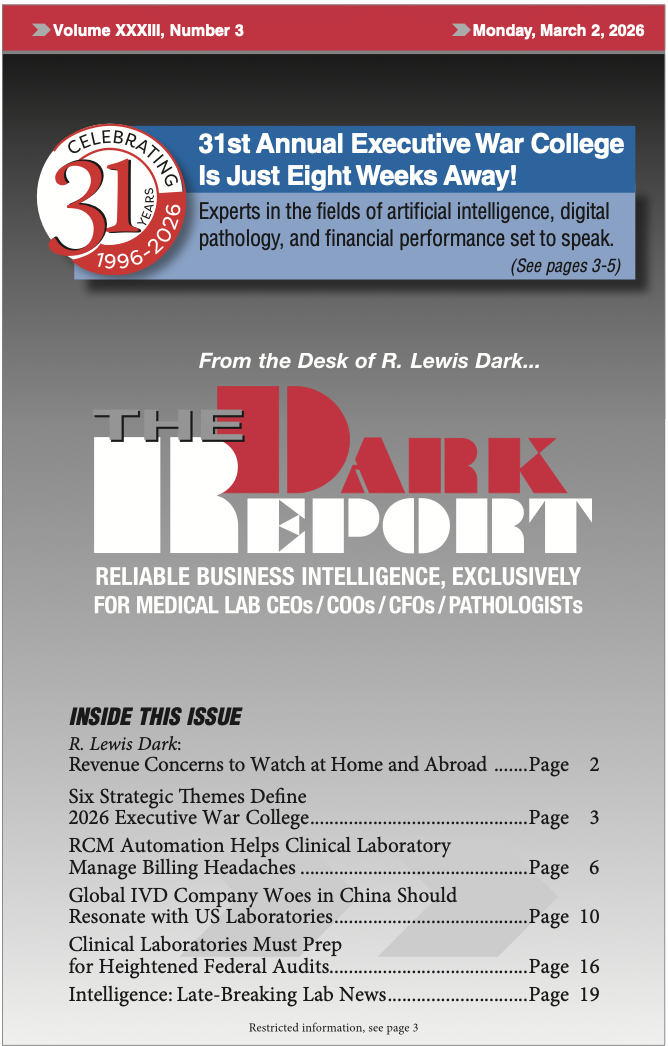
Volume XXXIII, No. 3 – March 2, 2026
The Dark Report highlights the six themes that will carry the 2026 Executive War College on Diagnostics, Clinical Laboratory, and Pathology Management,, including finance issues and AI. Also, we show how RCM automation helped one lab conquer billing headaches and increase revenue.
See the full table of contentsHow Much Laboratory Business Intelligence Have You Missed?
Lab leaders rely on THE DARK REPORT for actionable intelligence on important developments in the business of laboratory testing. Maximize the money you make-and the money you keep! Best of all, it is released every three weeks!
Sign up for TDR Insider
Join the Dark Intelligence Group FREE and get TDR Insider FREE!
Never miss a single update on the issues that matter to you and your business.
Topics
- Anatomic Pathology
- Clinical Chemistry
- Clinical Laboratory
- Clinical Laboratory Trends
- Digital Pathology
- Genetic Testing
- In Vitro Diagnostics
- IVD/Lab Informatics
- Lab Intelligence
- Lab Marketplace
- Lab Risk & Compliance
- Laboratory Automation
- Laboratory Billing
- Laboratory Compliance
- Laboratory Equipment
- Laboratory Information Systems
- Laboratory Management
- Lean Six Sigma
- Managed Care Contracts
- Molecular Diagnostics
- Pathology Trends
- People
- Uncategorized