

TAG:
in vitro diagnostics
In vitro diagnostics (IVDs) are diagnostic tests that that can detect diseases, conditions, or infections. In vitro diagnostics test a sample of tissue or bodily fluids, as opposed to testing inside the body, such as:
- Microbiological culture, which determines the presence or absence of microbes in a sample from the body, usually targeted at detecting pathogenic bacteria
- Genetic testing
- Blood glucose
- Liver function tests
- Calcium
Electrolytes in the blood, such as sodium, potassium, creatinine and urea.
In vitro tests can be classified according to the location of the sample being tested, including blood and urine tests.
Some tests are used health professional settings such as clinical laboratories, and other tests are for consumers to use at home. The expression “in vitro” comes from Latin, literally meaning “within the glass.” The name reflects the fact that historically such tests were conducted in glass vessels, such as test tubes.
Unlike other forms of medical technology, IVDs never interact directly with the human body. Their value stems from the information they provide. This sets IVDs apart from medical devices and pharmaceuticals, and is part of what makes them unique among health technologies.
In the U.S., in vitro diagnostics products are medical devices as defined in section 210(h) of the Federal Food, Drug, and Cosmetic Act, and may also be biological products subject to section 351 of the Public Health Service Act. Like other medical devices, IVDs are subject to premarket and postmarket controls. IVDs are also subject to the Clinical Laboratory Improvement Amendments (CLIA ’88) of 1988.
The IVD industry is growing steadily due to a number factors, such as increased demand for infectious disease testing as new pathogen strains develop each year, such as in seasonal influenza and H1N1, and increased incidences of hospital-acquired infections. Other factors include aging demographics common to all developed nations and the accompanying increased incidence of chronic disease across all age cohorts of the population; advances in DNA sequencing; and growing demand from emerging markets, which are only now becoming able to pay for diagnostic devices.
Revenue Concerns to Watch at Home and Abroad
By Scott Wallask | From the Volume XXXIII, No. 3 – March 2, 2026 Issue
This issue of The Dark Report explores…
Global IVD Woes in China Should Resonate with US Labs
By Mark Terry | From the Volume XXXIII, No. 3 – March 2, 2026 Issue
In vitro diagnostics (IVD) companies reported a mix of overall growth, with many noting continuing challenges in their diagnostics divisions for recent quarterly financial results. Thermo Fisher Scientific, QuidelOrtho, and Danaher reported the…
February 9, 2026, Intelligence: Late-Breaking Lab News
By Janette Wider | From the Volume XXXIII, No. 2 – February 9, 2026 Issue
Texas Attorney General Ken Paxton filed a lawsuit against Epic Systems, intensifying scrutiny of how pediatric medical records are controlled and the broader power of dominant electronic health record (EHR) vendors. The suit alleges Epic unlawfully monopolizes the EHR…
Patient-Driven Testing Spurs New Opportunities
By Janette Wider | From the Volume XXXIII, No. 2 – February 9, 2026 Issue
CEO SUMMARY: Patient-driven diagnostic testing is creating both opportunities and challenges for clinical laboratories, as increased demand and evolving business models stretch the industry’s capacity and profitability. However, an industry veteran in commercial lab prod…
FDA Reviews Oncology Companion Diagnostics
By Janette Wider | From the Volume XXXIII, No. 1 – January 19, 2026 Issue
CEO SUMMARY: Regulatory attorneys indicate that the FDA’s move to reclassify oncology companion diagnostics to Class II medical devices could speed approvals and reduce costs for submissions. From a business perspective, the proposal could allow clinical laboratories to …
Top Stories in 2025 Played Out in Courts, Capitol Hill
By Janette Wider | From the Volume XXXII, No. 18 – December 29, 2025 Issue
CEO SUMMARY: The biggest story of the year for clinical laboratories came in a huge court victory, as a federal judge vacated the FDA’s final rule on laboratory developed tests. Labs breathed a sigh of relief after the court decision, as the FDA rule had promised to incr…
Abbott Bets Hard on Cancer Diagnostics with New Deal
By Scott Wallask | From the Volume XXXII, No. 17 – December 8, 2025 Issue
Abbott Laboratories’ deal to acquire Exact Sciences for $23 billion emphasizes the value that the in vitro diagnostics (IVD) manufacturer puts on cancer testing. Clinical laboratories involved with oncology should monitor the progres…
Insights on Innovative Tech and Running a Clinical Lab in 2026
By Scott Wallask | From the Volume XXXII, No. 17 – December 8, 2025 Issue
CEO SUMMARY: William Morice II, MD, PhD, the CEO at Mayo Clinic Laboratories, discusses technology that intrigues him and the important steps clinical laboratory leaders can take to better steer revenue opportunities as they head into the new year. Morice also comments on …
Reforms in China Affect IVD Companies’ Q3 2025 Earnings
By Mark Terry | From the Volume XXXII, No. 16 – November 17, 2025 Issue
Most of the in vitro diagnostics (IVD) manufacturers that serve clinical laboratories worldwide reported facing financial “headwinds” in the China IVD market that affected their third-quarter performance. This was due to policy changes in the country…
What Private Equity Sees in Diagnostics
By Scott Wallask | From the Volume XXXII, No. 16 – November 17, 2025 Issue
CEO SUMMARY: Hologic’s acquisition by private equity firms Blackstone and TPG marks one of the year’s largest in vitro diagnostics transactions and a clear vote of confidence in the sector’s resilience. Industry analyst Bruce Carlson unpacks what the buyout …
CURRENT ISSUE
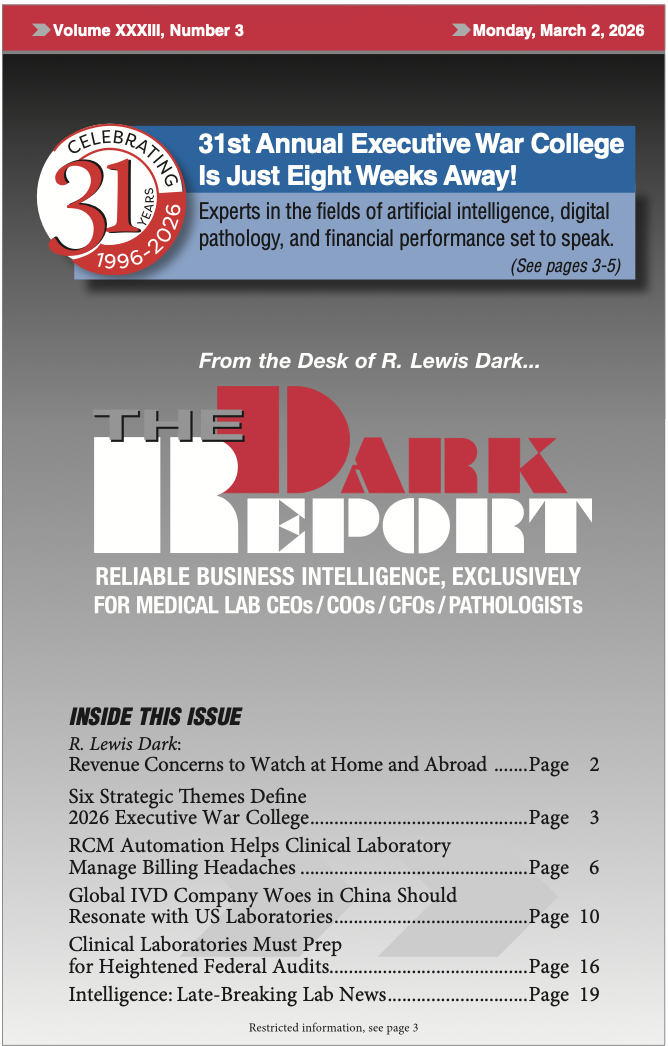
Volume XXXIII, No. 3 – March 2, 2026
The Dark Report highlights the six themes that will carry the 2026 Executive War College on Diagnostics, Clinical Laboratory, and Pathology Management,, including finance issues and AI. Also, we show how RCM automation helped one lab conquer billing headaches and increase revenue.
See the full table of contentsHow Much Laboratory Business Intelligence Have You Missed?
Lab leaders rely on THE DARK REPORT for actionable intelligence on important developments in the business of laboratory testing. Maximize the money you make-and the money you keep! Best of all, it is released every three weeks!
Sign up for TDR Insider
Join the Dark Intelligence Group FREE and get TDR Insider FREE!
Never miss a single update on the issues that matter to you and your business.
Topics
- Anatomic Pathology
- Clinical Chemistry
- Clinical Laboratory
- Clinical Laboratory Trends
- Digital Pathology
- Genetic Testing
- In Vitro Diagnostics
- IVD/Lab Informatics
- Lab Intelligence
- Lab Marketplace
- Lab Risk & Compliance
- Laboratory Automation
- Laboratory Billing
- Laboratory Compliance
- Laboratory Equipment
- Laboratory Information Systems
- Laboratory Management
- Lean Six Sigma
- Managed Care Contracts
- Molecular Diagnostics
- Pathology Trends
- People
- Uncategorized