

TAG:
Fee-for-service
Fee-for-service has long been the primary payment model for clinical laboratories and pathology groups. Fee-for-service (FFS) is a payment model in which services are paid for as itemized in the provider’s invoice. It gives an incentive for physicians to provide more treatments because payment is dependent on the quantity of care, rather than quality of care. Similarly, patients are incentivized to welcome any medical service that might not be necessary. Insurance companies shield themselves against ruin by setting cover limits for every beneficiary.
FFS raises costs, discourages the efficiencies of integrated care, and a variety of reform efforts have been attempted, recommended, or initiated to reduce its influence (such as moving towards bundled payments and capitation).
Medicare Parts A (hospital insurance) and B (optional insurance that covers physician, outpatient hospital, home health, laboratory tests, durable medical equipment, designated therapy, outpatient prescription drugs, and other services not covered by Part A) are FFS programs. Medicare processes over one billion FFS claims per year.
As part of the ongoing drive to cut healthcare costs, this model is gradually being phased out by payers and healthcare organizations in favor of value-based payment models, such as pay-for-performance programs and accountable care organizations that are intended to cap costs and spread financial risk among providers, while encouraging coordination of care, disease prevention and better management of chronic conditions. This is seen as a threat to the survival of clinical labs, which expect to see far fewer tests ordered by healthcare providers.
The Clinical Laboratory Management Association is working to help labs navigate these changes. “As fee-for-service reimbursement gives way to bundled reimbursement and per-member-per-month payment, labs will only be successful if they add value to physicians by helping them diagnose disease earlier and more accurately,” says CLMA President Paul Epner.
CLMA has named this program “Increasing Clinical Effectiveness,” or ICE. THE DARK REPORT is one of CLMA’s partners in this effort.
“Our hope is that ICE is a catalyst that helps lab administrators, pathologists, and medical laboratory scientists broaden the focus of their laboratory beyond operational efficiency to include measurable impact on positive patient outcomes,” says Epner.
CARESIDE POC Solution in entirety, the traditional way of performing tests in the To Alter Lab Organization
By Robert Michel | From the Volume VI No. 16 – November 22, 1999 Issue
CEO SUMMARY: CARESIDE’s point-of-care testing system gives laboratory executives a new tool for bringing value-added laboratory services to clinicians. In this exclusive interview, W. Vickery Stoughton, Chairman and CEO of CARESIDE, Inc., shares his perspectives on the clinical laborato…
Finally: Respect for Cytyc As Aetna OKs ThinPrep®
By Robert Michel | From the Volume VI No. 13 – September 20, 1999 Issue
CEO SUMMARY: Here’s an important development in the battle to get the healthcare community to accept new technology for the preparation of Pap smears. Aetna/U.S. Healthcare announced that it would cover the monolayer preparation tests offered by Cytyc and AutoCyte. Aetna’s decision ma…
West Hills Hospital Lab Hits Outreach Home Run
By Robert Michel | From the Volume VI No. 11 – August 9, 1999 Issue
CEO SUMMARY: Popular wisdom says that California’s managed care market is a financial disaster for clinical laboratories. Yet here’s an exciting story about a community hospital that launched a brand-new laboratory outreach program in 1997 and found solid success. During the last two …
Outsourcing Lab Outreach Leads to Better Service
By Robert Michel | From the Volume VI No. 11 – August 9, 1999 Issue
CEO SUMMARY: Many hospital laboratories continue to endure non-stop cutbacks to staffing and funding. The success of the recently instituted laboratory testing outreach program at West Hills Hospital and Medical Center validates that the market continues to reward labs willing to offer ad…
Ten Myths of Lab Management That Led the Clinical Lab Industry Astray
By Robert Michel | From the Volume VI No. 11 – August 9, 1999 Issue
Part One of a Special Series CEO SUMMARY: One of our most popular series ever was the “13 Perilous Parallels” of laboratory management. This four-part story appeared in 1996 and chronicled similar management strategies used by various national laboratories during the…
Wedding Between AutoCyte and NeoPath Will Spawn A Single Prep/Screen System
By Robert Michel | From the Volume VI No. 10 – July 19, 1999 Issue
CEO SUMMARY: Various technologies that automate cytology and Pap smear screening entered the clinical marketplace during the last four years. Because managed healthcare views new technology with a more skeptical eye than fee-for-service healthcare, THE DARK REPORT has provided extensive a…
PennState Geisinger Building “ Distributed Lab ” Around POCT
By Robert Michel | From the Volume VI No. 9 – June 28, 1999 Issue
CEO SUMMARY: Here’s an integrated healthcare system that’s pushing its clinical laboratory across traditional barriers between physician’s office and clinical lab. At PennState Geisinger Healthcare, a fast-growing health system located in rural Pennsylvania, point-of-care testing is…
Investors Coming Back To Clinical Lab Industry
By Robert Michel | From the Volume VI No. 8 – June 7, 1999 Issue
CEO SUMMARY: Wall Street money is beginning to flow back into the commercial laboratory industry. This time the beneficiary is Unilab Corporation of Tarzana, California. New York-based Kelso & Company signed an agreement to buy 93% of Unilab’s shares. The common perception among fin…
LabCorp Making Steady Progress On Path Back to Financial Health
By Robert Michel | From the Volume VI No. 7 – May 17, 1999 Issue
MOST OF THE LAB INDUSTRY is watching the impending acquisition by Quest Diagnostics Incorporated of SmithKline Beecham Clinical Laboratories (SBCL). This big news overshadows the steady gains made at Laboratory Corporation of America in its efforts …
Crises Management Plan Essential for Every Lab
By Robert Michel | From the Volume VI No. 6 – April 26, 1999 Issue
CEO SUMMARY: “It can’t happen here” is not good management. All clinical laboratories and pathology practices should anticipate the worst and develop their own internal controls to prevent the unthinkable and prepare for the unexpected. Rogue phlebotomists like the one at SmithKline…
CURRENT ISSUE
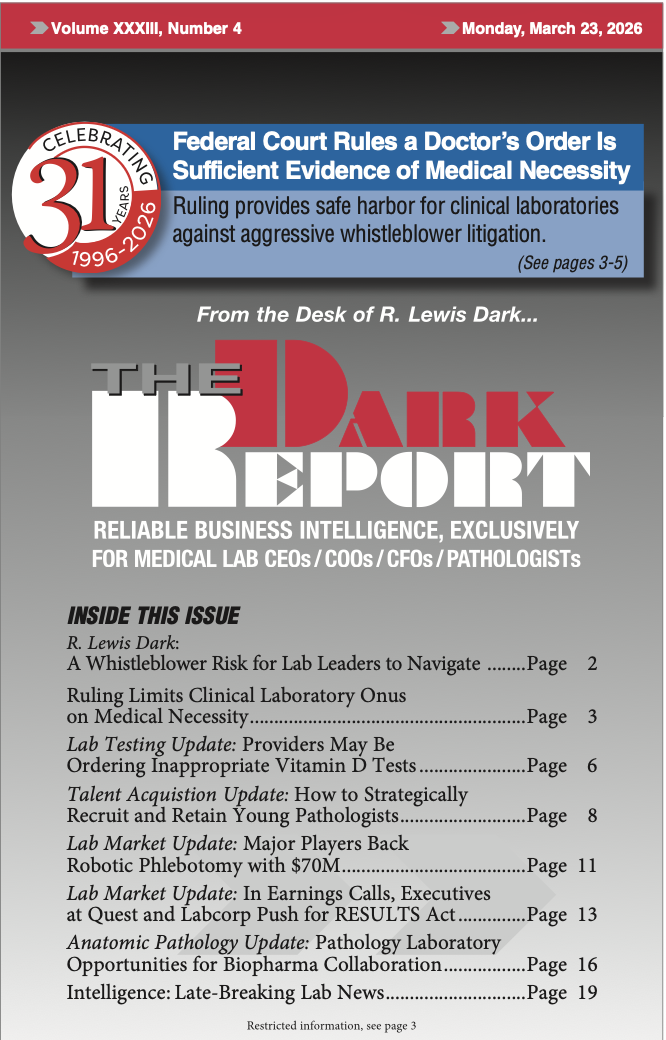
Volume XXXIII, No. 4 – March 23, 2026
A federal court ruling has established a safe harbor for clinical labs when they run tests ordered by physicians. Lab leaders should examine this briefing for pitfalls. Also, it turns out that providers may be ordering inappropriate vitamin D tests, according to one expert.
See the full table of contentsHow Much Laboratory Business Intelligence Have You Missed?
Lab leaders rely on THE DARK REPORT for actionable intelligence on important developments in the business of laboratory testing. Maximize the money you make-and the money you keep! Best of all, it is released every three weeks!
Sign up for TDR Insider
Join the Dark Intelligence Group FREE and get TDR Insider FREE!
Never miss a single update on the issues that matter to you and your business.
Topics
- Anatomic Pathology
- Clinical Chemistry
- Clinical Laboratory
- Clinical Laboratory Trends
- Digital Pathology
- Genetic Testing
- In Vitro Diagnostics
- IVD/Lab Informatics
- Lab Intelligence
- Lab Marketplace
- Lab Risk & Compliance
- Laboratory Automation
- Laboratory Billing
- Laboratory Compliance
- Laboratory Equipment
- Laboratory Information Systems
- Laboratory Management
- Lean Six Sigma
- Managed Care Contracts
- Molecular Diagnostics
- Pathology Trends
- People
- Uncategorized