

TAG:
Companion diagnostics
A companion diagnostic device can be an in vitro diagnostic device or an imaging tool that provides information that is essential for the safe and effective use of a corresponding therapeutic product. The use of an IVD companion diagnostic device with a particular therapeutic product is stipulated in the instructions for use in the labeling of both the diagnostic device and the corresponding therapeutic product, as well as in the labeling of any generic equivalents and biosimilar equivalents of the therapeutic product.
Because the companion diagnostic test is designed to be paired with a specific drug, the development of both products requires close collaboration between experts in both the Food and Drug Administration (FDA)’s device center, which evaluates the test to determine whether it may be cleared or approved, and FDA’s drug center, which evaluates the drug to determine whether it may be approved.
The process works best when development of the test begins before the drug enters clinical trials, increasing the likelihood that the participants in the trials are the patients most likely to benefit from the treatment.
Companion diagnostics can provide information such as the following:
- Test results that identify a population in which the therapeutic product will achieve greater (or little) effectiveness
- Test results that identify a patient population that should not receive a particular therapeutic product due to the possibility for therapy-related serious adverse events
- Test results that identify the characteristics of a disease, condition, or disorder to specifically determine what type of treatment is appropriate
- Test results that are the basis for selecting a safe and efficacious therapeutic dose.
Development of companion diagnostics has been supported by regulatory agencies, such as the FDA. The biopharmaceutical industry has also embraced the co-development of companion diagnostics, with companies either partnering on their development or pursuing in-house programs.
Genetic Engineering & Biotechnology News notes that a frequently cited example of a successful personalized therapeutic and companion diagnostic pair is Genentech’s antibody-based drug, Herceptin® (trastuzumab), which treats patients with cancers that overexpress the HER2 receptor (such as breast cancer), and the companion diagnostic test, HercepTest. The diagnostic test was developed to select patients that will benefit from treatment with Herceptin, a blockbuster drug.
Several Big Surprises in 2018’s Top 10 Lab Stories
By Robert Michel | From the Volume XXV No. 18 – December 24, 2018 Issue
CEO SUMMARY: This year’s list of the Top 10 Lab Industry Stories for 2018 is dominated by new directives from Medicare and private health insurers, as well as significant decisions by federal courts. Collectively, these developments create new compliance risks for all clinical laborator…
Powerful Forces Are Reshaping Lab, Pathology
By R. Lewis Dark | From the Volume XXV No. 5 – March 26, 2018 Issue
THERE IS NO BETTER WAY TO UNDERSTAND HOW THINGS ARE CHANGING within the house of laboratory medicine than to survey current news. Understanding why and how breaking news stories are indicators of deeply-rooted and forceful trends is essential for lab administrators and pathologists who want to keep t…
Why Pharma, Private Equity Want to Reshape Lab Industry
By Joseph Burns | From the Volume XXV No. 5 – March 26, 2018 Issue
CEO SUMMARY: A disruptive force that involves precision medicine, pharmaceutical companies, and venture capital investors is poised to reshape the clinical laboratory industry. Genetic knowledge makes it possible to match cancer drugs to specific mutations. Pharma companies and professio…
July 25, 2016 Intelligence: Late Breaking Lab News
By Robert Michel | From the Volume XXIII No. 10 – July 25, 2016 Issue
Throughout the profession of laboratory medicine, concern is surfacing following publication of a proposed rule by the Department of Veterans Affairs (VA) that would expand the authority of Advanced Practice Registered Nurses (APRNs) to supervise and perform laboratory testing. This …
Detroit Hospital Develops 10 Ways To Add More Value
By Joseph Burns | From the Volume XXII No. 12 – August 24, 2015 Issue
CEO SUMMARY: Clinical labs are beginning to make the transition from a volume-based financial model to a model based on value-based payments. To survive this transition, labs must find ways to create value. The lab at Henry Ford Health System has identified 10 ways that it c…
Investment Bank Bullish On Clinical Labs, Pathology
By Joseph Burns | From the Volume XXII No. 11 – August 3, 2015 Issue
CEO SUMMARY: For clinical laboratories and anatomic pathology groups willing to adapt to the evolving needs of the American healthcare system, there are many positive opportunities. That’s the view of a Wall Street investment bank that just published a report on the lab testing…
Opko Pays $1.47 Billion to Buy Bio-Reference Lab
By Robert Michel | From the Volume XXII NO. 9 – June 22, 2015 Issue
CEO SUMMARY: It’s a case of the little fish gobbling the big fish, as Opko Health – with revenue of $91 million – will be acquiring Bio-Reference Laboratories, with revenue of $832 million. But the more interesting aspect of the story is that the CEO of Opko Health is a physi…
February 17 Intelligence: Late Breaking Lab News
By Robert Michel | From the Volume XXII No. 3 – February 17, 2015 Issue
GeneCentric is a new lab testing company in Durham, North Carolina that was started by former executives of Laboratory Corporation of America. It intends to raise $20 million in a Series B capital offering. GeneCentric’s business model is to license molecular diagnostic tests, then develop the…
Labs Share Successes in Delivering More Value
By Robert Michel | From the Volume XXI No.16 – November 24, 2014 Issue
CEO SUMMARY: As the number of accountable care organizations and patient-centered medical homes grows monthly, a handful of innovative labs are seizing the opportunity to develop and deliver lab testing services that add more value to physicians and patients. These early-adopter labs reco…
FDA Notifies Congress that It Will Regulate LDTs
By Joseph Burns | From the Volume XXI No. 11 – August 11, 2014 Issue
CEO SUMMARY: Since 2006, the FDA has said it has the authority to regulate lab-developed tests, but it has held off on doing so. Now the agency says it’s time, defining LDTs as being, “designed, manufactured, and used within a single laboratory. LDTs include some genetic tests and tes…
CURRENT ISSUE
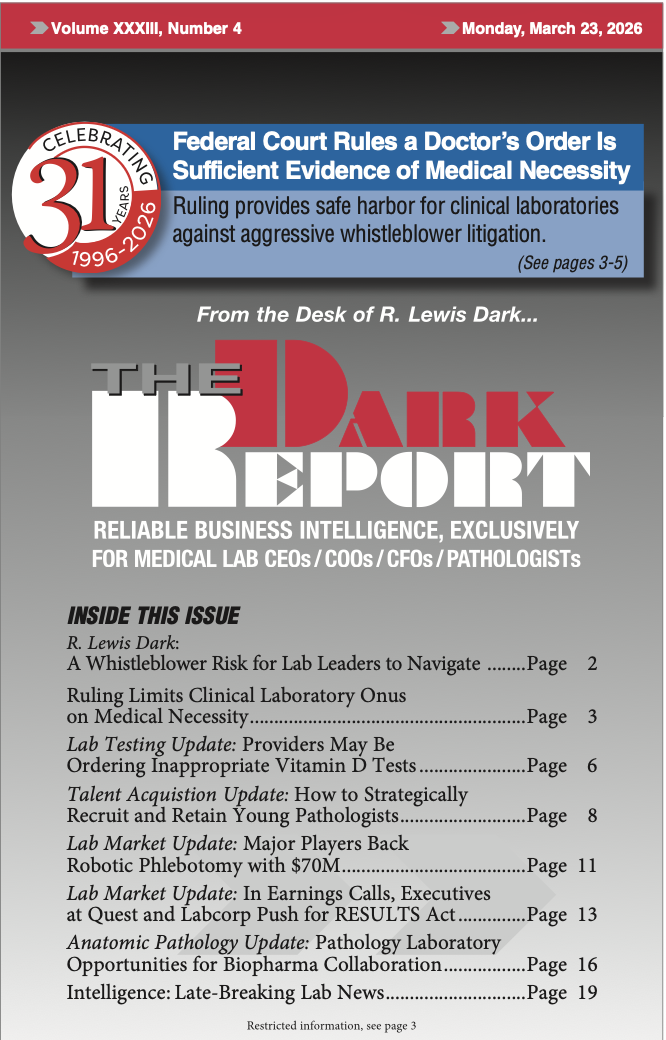
Volume XXXIII, No. 4 – March 23, 2026
A federal court ruling has established a safe harbor for clinical labs when they run tests ordered by physicians. Lab leaders should examine this briefing for pitfalls. Also, it turns out that providers may be ordering inappropriate vitamin D tests, according to one expert.
See the full table of contentsHow Much Laboratory Business Intelligence Have You Missed?
Lab leaders rely on THE DARK REPORT for actionable intelligence on important developments in the business of laboratory testing. Maximize the money you make-and the money you keep! Best of all, it is released every three weeks!
Sign up for TDR Insider
Join the Dark Intelligence Group FREE and get TDR Insider FREE!
Never miss a single update on the issues that matter to you and your business.
Topics
- Anatomic Pathology
- Clinical Chemistry
- Clinical Laboratory
- Clinical Laboratory Trends
- Digital Pathology
- Digital Pathology
- Genetic Testing
- In Vitro Diagnostics
- IVD/Lab Informatics
- Lab Intelligence
- Lab Marketplace
- Lab Risk & Compliance
- Laboratory Automation
- Laboratory Billing
- Laboratory Compliance
- Laboratory Equipment
- Laboratory Information Systems
- Laboratory Management
- Lean Six Sigma
- Managed Care Contracts
- Molecular Diagnostics
- Pathology Trends
- People
- Uncategorized