

TAG:
Histology
Histology
Histology is a branch of anatomy that deals with the study structure of animal and plant tissues that is only discernible with a microscope. It is also called microscopic anatomy, as opposed to gross anatomy, which involves structures that can be observed with the naked eye. The word “histology” is derived from two Greek words: histo, which means “tissue,” and logos, which means “study.”
Histopathology, the microscopic study of diseased tissue, is an important tool used in anatomical pathology, as accurate diagnosis of cancer and other diseases usually requires histopathological examination of samples.
Histological studies are often carried out by examining a thin slice (called a “section”) of tissue under a light microscope or an electron microscope on a prepared slide.
In order to distinguish different biological structures more easily and accurately, histological stains are often used to add colors to, or enhance the colors of, certain types of biological structures to allow them to be more easily differentiated from other types of structures. Staining is employed because biological tissue has little inherent contrast when observed using either light or electron microscopes.
Trained physicians, frequently licensed clinical pathologists, are the personnel who actually perform histopathological examinations and provide diagnostic information based on their observations of the tissues being tested.
The trained personnel who prepare histological specimens for examination may go by a number of titles, including:
- Histotechnician
- Histology technician (HT)
- Histology technologists (HTL)
- Medical scientists
- Medical laboratory technician
- Biomedical scientist
Their field of study is called histotechnology.
Histology has seen recent changes as technological advances in automation have influenced the field. Automation allows for the reduction of the workload of manual task needed to prepare and track histology specimens. Artificial intelligence also is playing a growing role in supporting the analysis of sections, supporting anatomic pathologists during their examinations of samples.
Process Improvement Coming to Healthcare
By Robert Michel | From the Volume XIX No. – October 8, 2012 Issue
CEO SUMMARY: One new byword coming to healthcare in the United States is the “continuously-learning healthcare system.” At the upcoming Lab Quality Confab in San Antonio next month, lab managers and pathologists can learn more about how to achieve and sustain continuous improvement in…
Leica, Aperio, Myriad, AMP, Hologic, Gen-Probe
By Robert Michel | From the Volume XIX No. 12 – August 27, 2012 Issue
LEICA BIOSYSTEMS TO ACQUIRE APERIO FOR THE SECOND TIME IN AS MANY YEARS, a global leader in histology systems and products has announced that it will acquire one of the leading digital pathology companies. This time it is Leica Biosystems of Nussloch, German…
MD Self-Referral Issues Target of Utilization Study
By Robert Michel | From the Volume XIX No. 6 – April 23, 2012 Issue
CEO SUMMARY: When it comes to the in-office ancillary service (IOAS) exception to physician self-referral, the issue of in-clinic pathology services has become a hot potato. Publication in Health Affairs of a study of urologists’ self-referral of their patients for anatomic pathology se…
QMS Helps Ontario Labs Cut Errors, Improve TAT
By Joseph Burns | From the Volume XIX No. 4 – March 12, 2012 Issue
CEO SUMMARY: In Brampton and Etobicoke, Ontario, the hospital laboratories of William Osler Health System are using the quality management system of ISO 15189 to stay ahead of two powerful trends. Combining the QMS with Lean methods allows the labs’ management and staff to continuously …
Quest Diagnostics and LabCorp Report Q-4, Full Year Earnings
By Robert Michel | From the Volume XIX No. 4 – March 12, 2012 Issue
IN RECENT WEEKS, each of the nation’s two largest public laboratory companies reported earnings for fourth quarter 2011 and full year 2011. Organic growth at both lab companies continues at low single-digit rates. This continues the pattern of relatively modest growth that has been posted by each …
Shaw & Adelman Successful Support of Lab Networks Need Hospital Leadership
By Joseph Burns | From the Volume XIX No. 3 – February 20, 2012 Issue
CEO Summary: In the second installment of our exclusive two- part interview, the executive directors of two regional laboratory networks formed in the 1990s (one in Michigan and one in Washington State) share their assessment of why their respective lab networks have performed strongly ov…
Allina Opens State-of-the-Art Central Laboratory Facility
By Robert Michel | From the Volume XVIII No. 17 – December 19, 2011 Issue
THIS MONTH, THE NATION’S NEWEST “designed from scratch” clinical laboratory facility began operating in Minneapolis, Minnesota. It is the central laboratory of Allina Hospitals & Clinics and its design is rooted in Lean and similar process improvement and workflow principle…
Anatomic Path Insourcing Expected to Be Ongoing
By Robert Michel | From the Volume XVIII No. 16 – November 28, 2011 Issue
CEO SUMMARY: Insourcing of anatomic pathology services by office-based physicians has been especially prevalent and is increasing among three specialties (gastroenterology, urology, and dermatology), according to a survey conducted last month. Survey respondents also indicated that the tr…
In-Practice Histology Lab Splits Biopsies; ID’s Patient with DNA
By Robert Michel | From the Volume XVIII No. 14 – October 17, 2011 Issue
In response to continuing requests by clients and readers of THE DARK REPORT, this issue institutes a new feature titled “Lab Fraud Watch.” It will provide information about activities in the medical laboratory testing marketplace which could be interpreted as violatin…
August 15, 2011 “Intelligence: Late Breaking Lab News”
By Robert Michel | From the Volume XXVIII No. 11 – August 15, 2011 Issue
Last Friday, the acquisition of Southern Diagnostic Laboratories, Inc., of Birmingham, Alabama, was announced by Solstas Lab Partners of Greensboro, North Carolina. Steve Boyd, who is the Founder and CEO of Southern Diagnostics, will become a Senior Vice President at…
CURRENT ISSUE
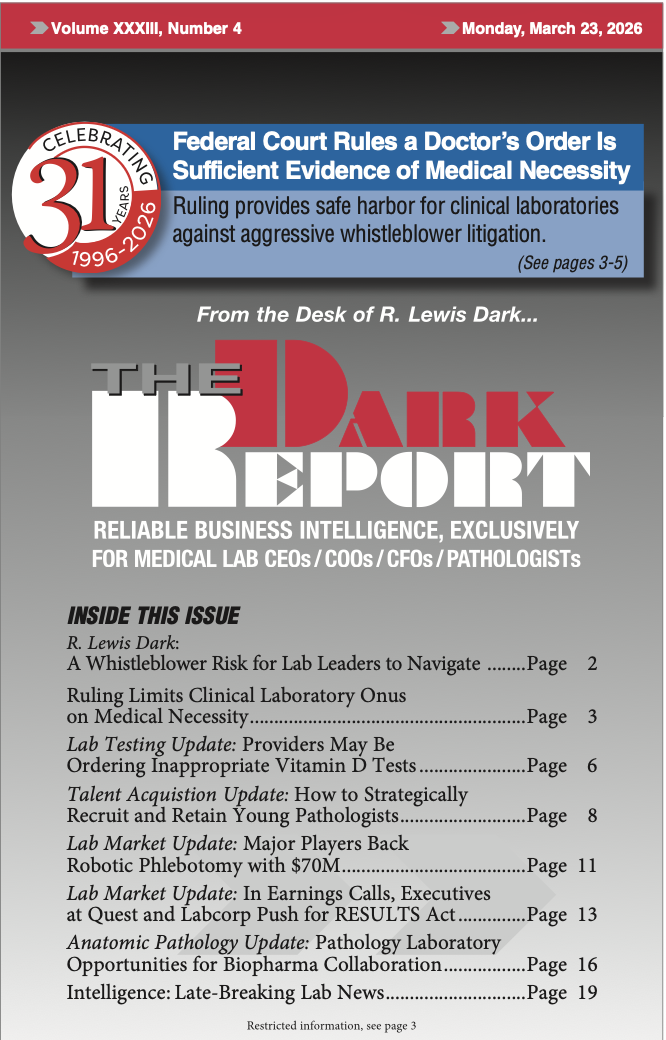
Volume XXXIII, No. 4 – March 23, 2026
A federal court ruling has established a safe harbor for clinical labs when they run tests ordered by physicians. Lab leaders should examine this briefing for pitfalls. Also, it turns out that providers may be ordering inappropriate vitamin D tests, according to one expert.
See the full table of contentsHow Much Laboratory Business Intelligence Have You Missed?
Lab leaders rely on THE DARK REPORT for actionable intelligence on important developments in the business of laboratory testing. Maximize the money you make-and the money you keep! Best of all, it is released every three weeks!
Sign up for TDR Insider
Join the Dark Intelligence Group FREE and get TDR Insider FREE!
Never miss a single update on the issues that matter to you and your business.
Topics
- Anatomic Pathology
- Clinical Chemistry
- Clinical Laboratory
- Clinical Laboratory Trends
- Digital Pathology
- Genetic Testing
- In Vitro Diagnostics
- IVD/Lab Informatics
- Lab Intelligence
- Lab Marketplace
- Lab Risk & Compliance
- Laboratory Automation
- Laboratory Billing
- Laboratory Compliance
- Laboratory Equipment
- Laboratory Information Systems
- Laboratory Management
- Lean Six Sigma
- Managed Care Contracts
- Molecular Diagnostics
- Pathology Trends
- People
- Uncategorized